
Sometimes you know that something in your life is not working long before you know what to call it.
You may notice the same reaction appearing again, a decision that never seems to settle, a relationship pattern that keeps repeating, a loss of direction, or simply the sense that the way you have been living no longer fits.
The Human Journey Architecture is a way of making that experience easier to see. It does not begin by diagnosing you or deciding what your problem means. It begins with your lived experience and follows the journey from recognition towards understanding, orientation and movement.
From lived experience to movement
The outer journey is:
Lived Experience → Recognition → Reflection → Atlas → Orientation → Integration → Movement → Outcome / New Lived Experience
This is not a rigid sequence that everybody must follow in the same way. People can enter at different places, move backwards and forwards, revisit earlier questions and discover new meaning as circumstances change.
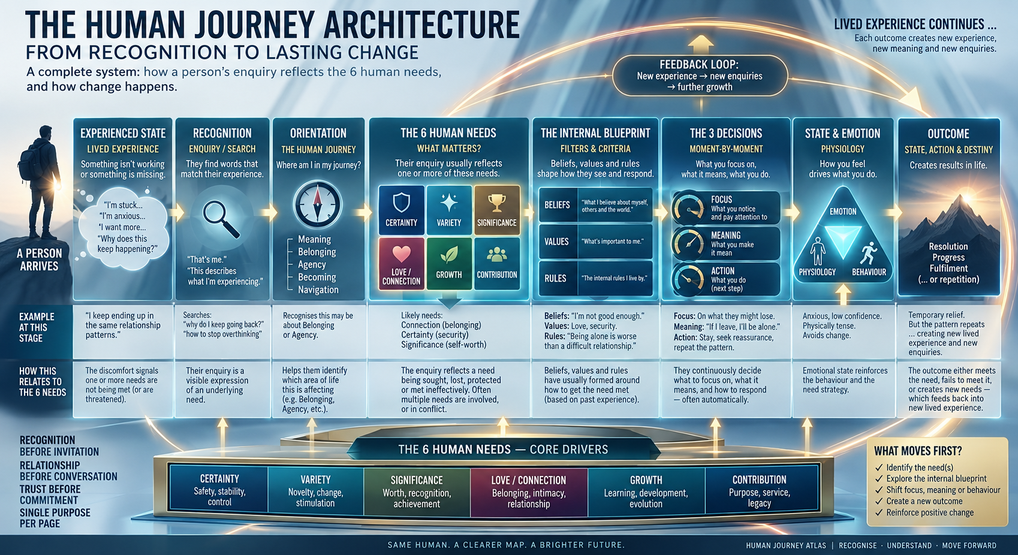
The Human Journey Architecture — a visual exploration of lived experience, recognition, human needs, beliefs, values, rules, focus, meaning, state, behaviour and outcome.
A problem can be the beginning of an enquiry
Recognition often begins before explanation. You may search for a symptom, a question, a feeling, a pattern or a situation because that is the part you can see.
But the same visible problem can be maintained by very different things in different people. Two people can describe the same behaviour while giving it different meanings, protecting different values, following different internal rules and responding to different needs.
That is why the Human Journey Architecture does not treat the presenting problem as the whole story. Recognition is an entrance. The next task is exploration.
The Five Human Questions
The Human Journey Atlas uses five broad questions to help locate the territory you may be exploring.
- Meaning — What does this mean to me, and what am I making it mean?
- Belonging — Where do connection, acceptance, care and relationship fit?
- Agency — What can move, what can I influence, and what might move first?
- Becoming — Who am I becoming, and what no longer fits?
- Navigation — Where am I now, and what is the most useful direction from here?
These are not five boxes that people belong in. They are different ways of looking at a human situation. A single experience may involve several of them at once.
You can explore meaning through Behind The Signs, belonging through Someone Still Cares, agency through What Moves First, becoming through What’s Becoming of Me, and wider navigation through Brightening Futures.
What might be happening underneath?
One useful interpretive lens is the Six Human Needs: certainty, variety or uncertainty, significance, love or connection, growth and contribution.
They are not diagnoses and they are not intended to categorise a person. They can simply help open a better question:
What might this behaviour, reaction or pattern be seeking, protecting or maintaining?
A behaviour that looks unhelpful from the outside may still be serving an important function for the person experiencing it. It may help preserve certainty, protect connection, avoid a feared loss of significance, create variety, support growth, or maintain some other personally meaningful outcome.
The useful task is not to assume which need is operating. It is to explore what the experience is doing in that particular person’s internal world.
The internal human architecture
Beneath the visible experience there can be many interacting influences:
Needs ↔ Values ↔ Beliefs ↔ Rules ↔ Expectations ↔ Meaning
These interact with:
Focus / Attention ↔ State ↔ Available Choices ↔ Behaviour / Action
The arrows matter. This is not intended as a one-way chain in which one element always causes the next. Human experience is recursive. What you believe can influence what you notice. What you notice can influence your state. Your state can change the choices that feel available. What you then do can create an outcome that strengthens, challenges or reorganises what you believed in the first place.
Focus, meaning and action
At any moment, attention is selective. We do not respond to every possible part of an experience equally. What comes into focus, what we expect, and what we make something mean can influence the state from which we act.
This does not mean that every problem is simply a matter of mindset. It means that understanding the structure of an experience can reveal places where movement may become possible.
Sometimes movement begins with a different interpretation. Sometimes it begins with a boundary, a conversation, a new piece of information, a change in attention, a practical decision or a different action. The architecture is a map for enquiry, not a prescription for what everybody should do.
What moves first?
When a situation feels large, the most useful question is not always, “How do I fix everything?” A smaller question may create more movement:
What can move first?
That is the territory explored by What Moves First. It shifts attention from solving an entire life at once towards identifying the next meaningful point of movement.
A recursive journey
An outcome is not necessarily the end of the Human Journey. An outcome becomes new lived experience.
That new experience can generate fresh recognition, new questions, deeper reflection and another period of orientation. A decision that once felt right may later need revisiting. A belief that once protected you may no longer be useful. A difficult experience can become information. An old pattern can become the point from which something different begins.
This is why the architecture is drawn as a continuing journey rather than a straight path to a final state.
Principles behind the map
- Recognition before invitation. Begin with what the person already knows or feels.
- Relationship before conversation. Trust and relevance matter before commitment.
- Exploration before conclusion. Do not impose an explanation before the person’s own structure is understood.
- Multiple entrances. People may arrive through recognition, orientation or discovery.
- Single purpose. Each page should help with one clear part of the journey.
- A recursive journey. Outcomes become new experience and may create new enquiries.
The person remains at the centre
The Human Journey Architecture is not intended to make the framework more important than the person using it.
The map is useful only if it helps you recognise where you are, understand what may be happening, and see a more relevant next step. It is an orientation tool, not a verdict about who you are.
Your experience is the starting point, not the diagnosis.
Recognise where you are. Understand what may be happening. Discover what could move next.
Sharing and attribution
The Human Journey Architecture may be shared or referenced with attribution to Human Journey Atlas and a link to this original source page.
Suggested attribution: Human Journey Architecture — Human Journey Atlas